Review · BOSNIA AND HERZEGOVINA
Sarajevo: City Tour with Bosnian coffee ritual ☕️
Sarajevo’s story is best understood over coffee, baklava, and a walk between churches, mosques, markets, and bridges. This tour moves from the Slavs and medieval Bosnia through Ottoman rule, Austro-Hungarian Sarajevo, the World Wars, and Tito’s Yugoslavia without turning the day into a classroom lecture.
I like the small group of up to eight, which gives you a real chance to ask questions and keep the walk moving at a human pace. I also like the food stops: Bosnian coffee, baklava, cured meats, cheeses, and a bakery visit give the city’s past a taste and texture.
The main consideration is time. At 210 minutes, this is a full walking tour with many stops, so some places are seen from the outside or explained briefly rather than explored at length. It is a good first look, not a substitute for several separate museum visits.
Key points to know before booking
- Bosnian coffee is part of the experience: You learn the local ritual and taste coffee prepared and served in the traditional way.
- The route crosses Sarajevo’s religious and cultural lines: Expect the Jewish Museum, Gazi Husrev-beg Mosque, two Christian cathedrals, and other major landmarks.
- Baščaršija comes with a crafts lesson: At Kazandžiluk, you can watch a traditional coppersmith at work.
- Food is woven into the walk: Stops include baklava, a local bakery, and samples of cheese and cured meats at the city market.
- The history runs from the Slavs to Tito: The guide connects Sarajevo’s medieval, Ottoman, Austro-Hungarian, wartime, and Yugoslav chapters.
- The format suits curious first-time visitors: A live guide leads the walk in English, German, Bosnian, Croatian, or Serbian.
Starting beside the Sacred Heart Cathedral
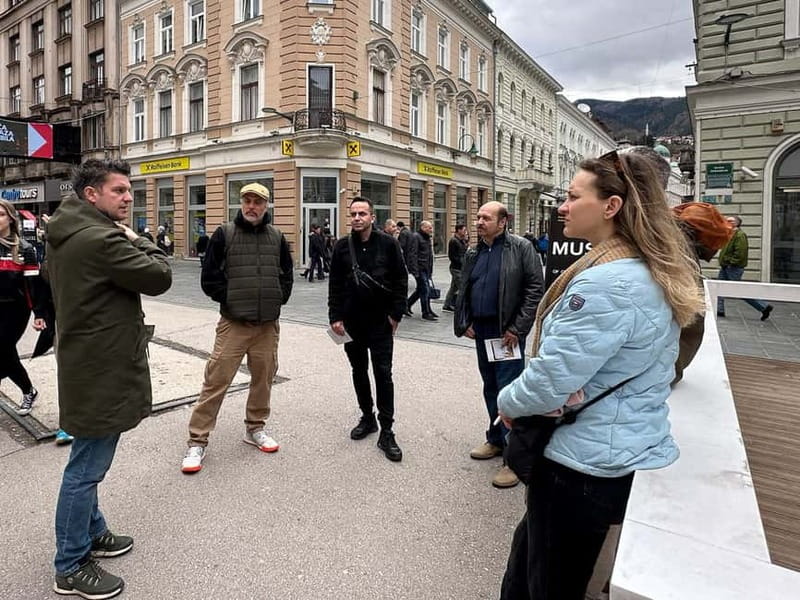
Meet your guide beside the statue of Pope John Paul II, next to Sarajevo’s Sacred Heart Cathedral. This is a useful starting point because the cathedral places you close to several of the city’s religious and historical layers from the first minute.
Sarajevo is often called the Jerusalem of Europe because different faiths have long shared a relatively compact urban area. This tour makes that idea concrete. You do not just hear about religious coexistence in general terms. You walk between Catholic, Orthodox, Jewish, and Muslim landmarks.
The route begins with a sense of contrast. The cathedral’s Catholic setting leads into streets shaped by Ottoman culture, Austro-Hungarian planning, and later Yugoslav life. I like this approach because Sarajevo’s story makes more sense when you see the changes in the street plan rather than treating each building as an isolated sight.
More Coffee Ceremony Experiences in the world:
- Ethiopian Culinary Tour – Market, Food, Coffee Ceremony & more
★ 5.0 · 65 reviews - Ethiopian Culinary Tour – Market, Coffee Ceremony and More
★ 5.0 · 10 reviews - Lalibela: Churches Full-Day Private Tour w/Coffee Ceremony
★ 4.7 · 5 reviews
The Jewish Museum and Sarajevo’s many faiths
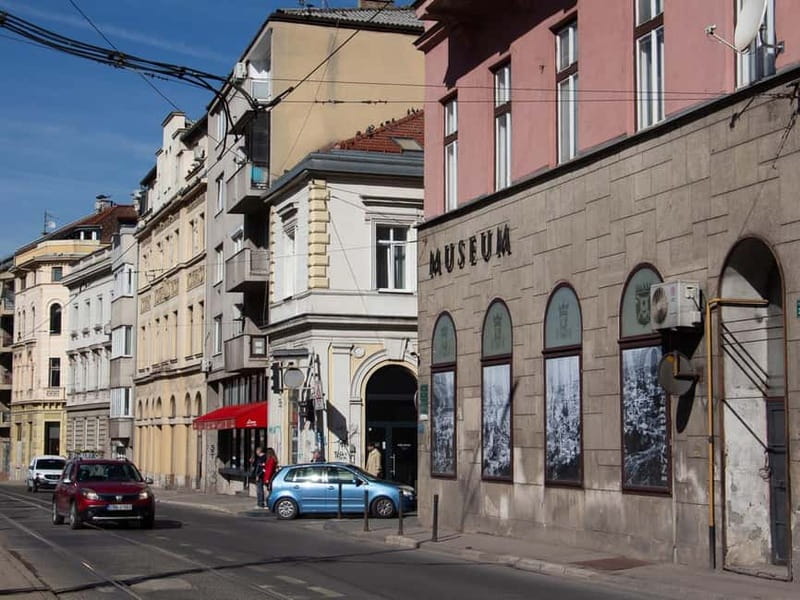
The Museum of the Jews of Bosnia and Herzegovina is one of the more important stops early in the walk. You receive a guided visit, not just a quick photograph outside, and it adds a necessary Jewish chapter to Sarajevo’s story.
The museum helps explain why the city’s religious identity cannot be reduced to one tradition. Along with the mosque and Christian churches on the route, it gives you a clearer picture of a city shaped by different communities and periods of rule.
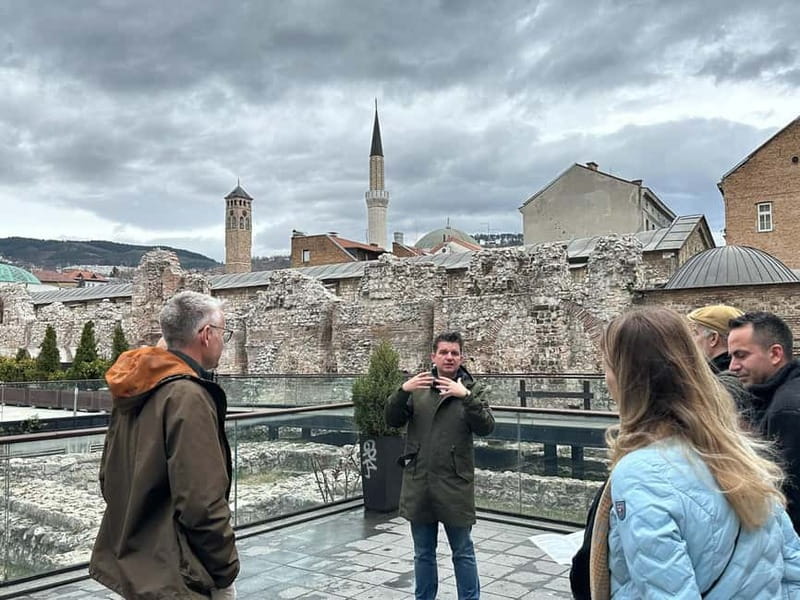
The tour also visits the Sarajevo Meeting of Cultures marker. This is a simple but effective place to pause because it shows where the Ottoman and Austro-Hungarian parts of the city meet. One side feels connected to the eastern, Ottoman-influenced quarter. The other points toward the western architectural style introduced under Austro-Hungarian administration.
Do not expect a long museum session here. The value is in the connection between the stop and the streets around it. If you want detailed exhibitions, religious art, or archival material, plan separate museum time later.
Gazi Husrev-beg Mosque and the Ottoman center
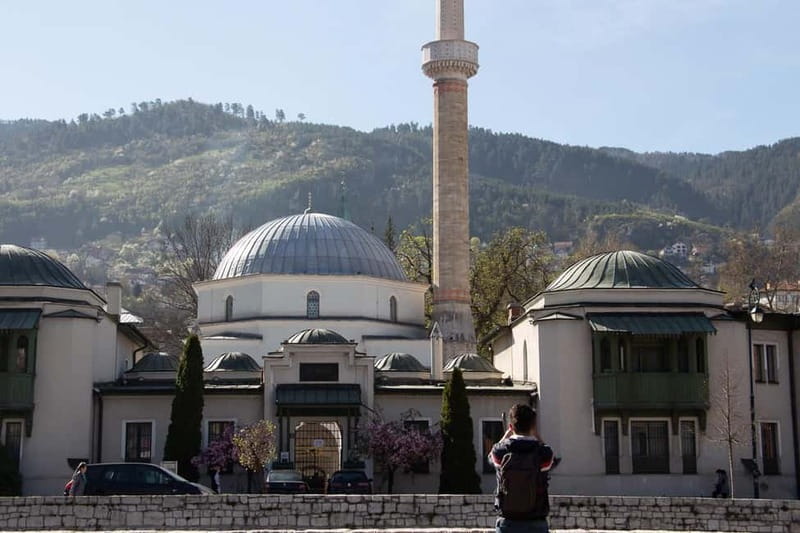
The visit to Gazi Husrev-beg Mosque is one of the cultural high points. Your guide provides an explanation inside or around the mosque, depending on the conditions of the visit, and places the building within Sarajevo’s Ottoman period.
This is a valuable stop even if you have already seen mosques elsewhere. The mosque is tied closely to the old commercial center, the market streets, and the daily life of Baščaršija. The tour helps you read the surrounding quarter as more than a collection of souvenir shops.
Dress and behavior matter at a religious site. Follow the guide’s instructions, keep your voice low, and be prepared for any site-specific rules. The supplied information does not state a dress code or whether head coverings are provided, so bring a respectful outfit rather than assuming every need will be handled on site.
Bakery treats and the food culture of Baščaršija
A stop at a local bakery brings the walking tour into everyday Sarajevo. It is a small detail, but I like it because food gives you a way to understand the city beyond monuments and dates.
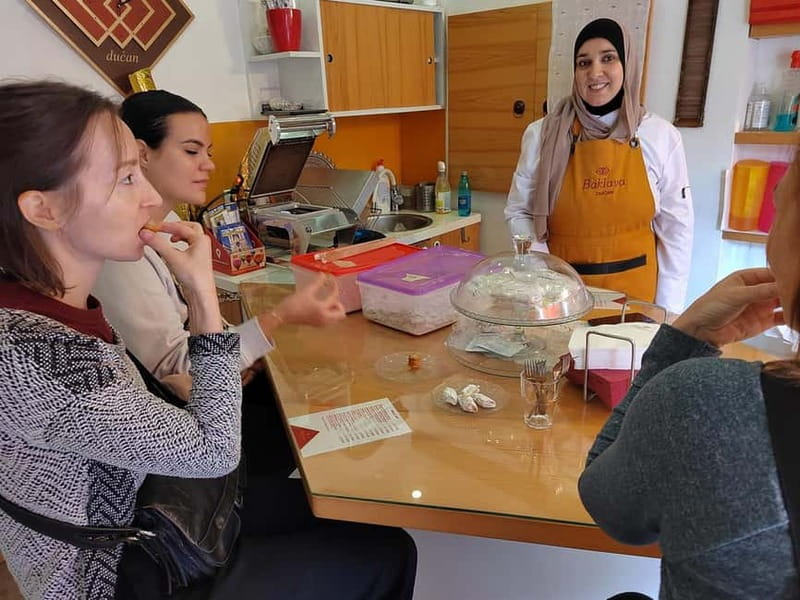
The tour also includes a sample of baklava from a traditional producer. Bosnian baklava is sweet and rich, so this is not a large dessert course. Think of it as a tasting that works well with the coffee later.
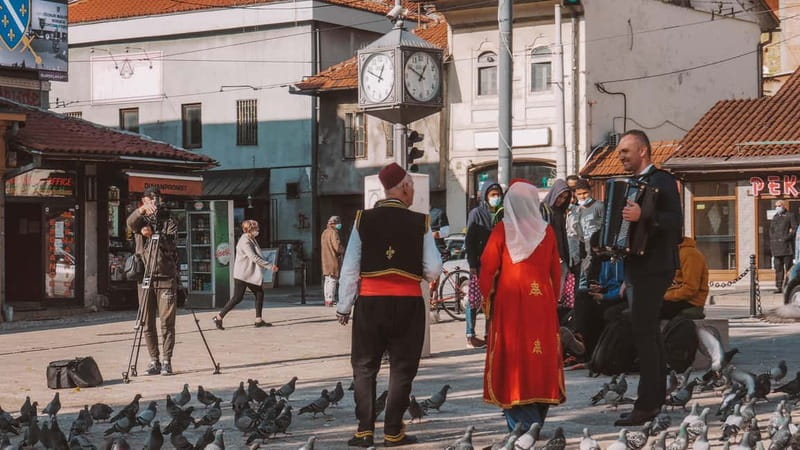
Baščaršija is the center of the old Ottoman quarter and one of the places where the tour feels most alive. You walk through streets associated with trade, food, religion, and craft production. The guide explains the area rather than simply pointing out its most photographed corners.
You will have less freedom to browse than you would on a self-guided visit because the group needs to keep moving. That is the tradeoff. You get context and a planned route, but you may want to return on your own if a shop or café catches your eye.
More Coffee Tours in the world:
- Hanoi Coffee Experience: 6 Brews, 9 Recipes & 3 Liquor Tastings
★ 5.0 · 2,945 reviews - Medellin: Coffee Tour with Transport, Snacks and Tastings
★ 4.7 · 1,357 reviews - Istanbul: Turkish Coffee Making and Fortune Telling Workshop
★ 4.9 · 1,308 reviews - Hanoi Coffee Workshop: Taste Salt, Coconut and Egg Coffee
★ 5.0 · 1,286 reviews
Kazandžiluk and the sound of copper work
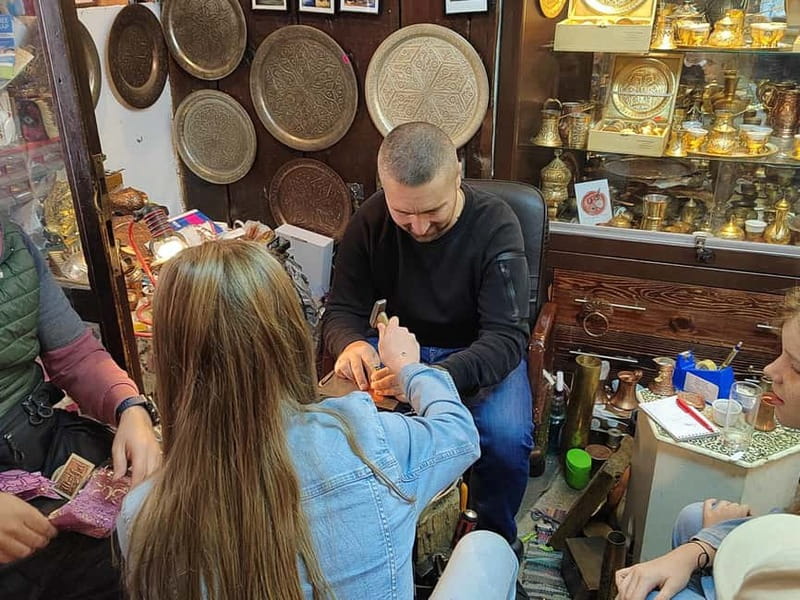
Kazandžiluk is Sarajevo’s traditional coppersmith street, and the visit to a local workshop adds something you cannot get from a standard monument walk. You see the craft in practice and learn about techniques passed down through generations.
The point is not only shopping. Watch how much work goes into the decorated trays, coffee sets, and other copper objects before deciding if you want to buy something. A workshop visit can help you tell the difference between a handmade piece and a mass-produced souvenir, although the tour does not promise a shopping discount or a particular item.
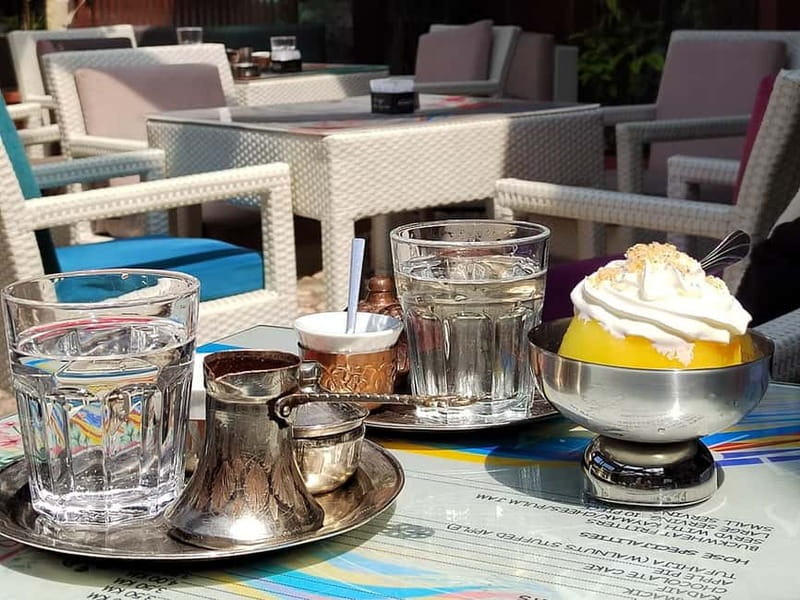
This is one of the route’s strongest authentic touches. The city’s coffee culture and copper craft also connect directly. Traditional Bosnian coffee is often served in a small copper pot and cup set, so the craft and the ritual are not separate subjects.
The Bosnian coffee ritual at a local café
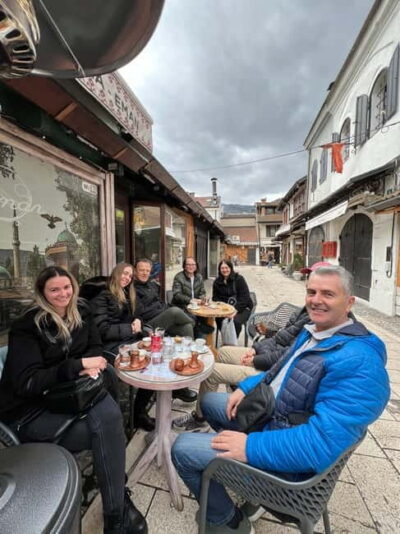
The coffee tasting is more than a caffeine break. Your guide explains how Bosnian coffee is prepared and served, then introduces the ritual at a local café.
Expect strong coffee and a small, deliberate serving rather than a large takeaway cup. The tour also covers three kinds of coffee people drink at home, according to the supplied description, giving you a practical point of comparison between local habits and the café culture you may know elsewhere.
Coffee comes with social meaning here. It is connected to sitting, talking, welcoming people, and taking time. That makes the tasting especially useful after the faster pace of the market streets.
If you do not drink coffee, the supplied details do not specify a replacement beverage. Ask before booking if this matters to you. The food and drink inclusions are limited to the stated tastings, so additional café orders are not included.
Sarajevo City Hall and the Austro-Hungarian chapter
Sarajevo City Hall is among the route’s most striking architectural stops. The guided visit places it within the period when Austro-Hungarian rule reshaped parts of the city.
The building helps you see how Sarajevo changed from an Ottoman commercial center into a city with new administrative buildings, public institutions, and European architectural influences. It is a strong visual companion to the Sarajevo Meeting of Cultures marker earlier in the walk.
The route does not promise a long interior tour or a private visit. Still, even a guided look at the building can give you a better sense of the political changes that shaped the city. If you want to study the interior in detail, check the amount of time available when you arrive.
Latin Bridge and the weight of Sarajevo’s past
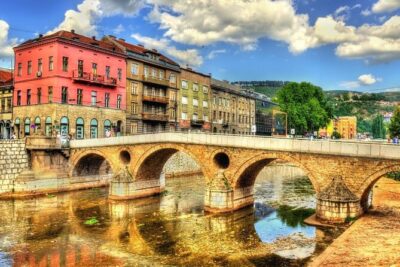
Latin Bridge is a short stop with a very large historical shadow. The guide connects it with the events that helped trigger the First World War, making it one of the places where a local street corner links to world history.
This is a good example of why a guide helps. You can cross the bridge alone and miss the wider political setting. With context, the stop becomes part of Sarajevo’s story of empire, conflict, and changing borders.
The tour also covers the World Wars and the Yugoslav era, including the role of Tito. Those chapters can be difficult to fit into one city walk, so expect a clear outline rather than a detailed political seminar. You leave with the basic sequence and the right questions for further reading.
The City Market Hall, local cheese, and cured meats
The City Market Hall gives you another look at Sarajevo’s daily life. Here, the tour includes samples of local cheeses and cured meats, turning the market into both a cultural stop and a tasting.
This is a useful counterweight to the grand buildings. Markets show what people eat, sell, and buy today. You can connect the earlier bakery and baklava stops with the more savory products at the market.
The food samples are included, but other food and drinks are not. If you are hungry for a full meal, plan to eat before or after the tour. The route is long enough that you should not count on the tastings alone to replace lunch.
The Eternal Flame and the city’s modern memory
The Eternal Flame is one of Sarajevo’s key modern landmarks. The guide explains its place in the city and uses it to connect the older quarters with Sarajevo’s twentieth-century story.
By this point, the tour has moved from religious buildings and Ottoman streets to Austro-Hungarian architecture, World War history, Yugoslavia, and modern civic memory. The sequence helps you see that Sarajevo is not one historic district frozen in time. It is a city built from several periods that remain close together.
The final cathedral stop, the Cathedral Church of the Nativity of the Theotokos, returns the focus to Sarajevo’s Orthodox community. Along with the Catholic cathedral, mosque, and Jewish Museum, it completes the religious picture introduced at the beginning.
Who gets the most from this three-and-a-half-hour walk
I would choose this tour if you have limited time in Sarajevo and want a strong first orientation. It covers the main sights, adds food and coffee, and gives you a useful framework for exploring on your own afterward.
It is also a good fit if you prefer history told through places rather than long museum displays. The guide aims to avoid an overload of dates and facts, which should suit you if you want clear stories and local context.
The tour may be less suitable if you want long, quiet visits at every site. With a 210-minute schedule and many landmarks, the pace has to be steady. You will also spend much of the experience walking and standing, so comfortable shoes are sensible.
A group limit of eight is a real advantage. It keeps the experience more personal than a large coach tour and should make questions easier. The available guide languages are English, German, Bosnian, Croatian, and Serbian.
Is $38 a fair price?
At $38 per person, the value depends on how you would otherwise organize your day. You are paying for a 210-minute guided walk, a small group, visits to major landmarks, a coffee ritual, a workshop stop, and several tastings.
The price makes sense if you would otherwise pay separately for a city tour, coffee experience, and food sampling. It is less attractive if you mainly want photographs of the major buildings and prefer to explore Sarajevo at your own pace.
The strongest value comes from the connections. The copper workshop relates to coffee. The market relates to local food. The religious sites relate to the Jerusalem of Europe nickname. The bridge, City Hall, and Eternal Flame link the city’s modern political story. You are not simply checking off sights.
Free cancellation up to 24 hours before the start and the option to reserve now and pay later make planning easier, especially if your Sarajevo schedule is still shifting. Check the available starting times before booking.
Should you book this Sarajevo city tour?
Book it if you want a compact, friendly introduction to Sarajevo that combines major landmarks with local food, coffee, and craft. The small group and multilingual guide make it a practical choice for first-time visitors, couples, and solo travelers who want company without a large tour crowd.
Skip it if you prefer slow museum visits, private exploration, or a tour focused on only one period of history. For most visitors with a short stay, though, the mix is well judged. You get the essential city sights, a sense of Sarajevo’s many communities, and several flavors that help the place stay in your memory after the walking ends.
FAQ
Where does the tour start?
You meet your guide next to the statue of Pope John Paul II, beside the Sacred Heart Cathedral in Sarajevo.
How long does the tour last?
The tour lasts 210 minutes, or three and a half hours.
What languages are available?
The live guide can lead the tour in German, English, Bosnian, Croatian, or Serbian.
How large is the group?
The experience is limited to a maximum of eight participants.
Is Bosnian coffee included?
Yes. The tour includes one cup of Bosnian coffee prepared and served in the traditional way, along with an explanation of the coffee ritual.
What foods are included?
The tour includes a bakery tasting, baklava from a traditional producer, and samples of local cheeses and cured meats at the city market. Other food and drinks are not included.
Does the tour visit a coppersmith workshop?
Yes. You visit a local workshop in Kazandžiluk and see traditional copper work.
Can I cancel for a full refund?
Yes. You can cancel up to 24 hours in advance for a full refund. You can also reserve your place and pay later.
Freshly brewed listings in the world
- Vietnamese Coffee 101 Workshop★ 5.0 · 11 reviews
- Vietnamese Coffee Making Class in Hoi An★ 5.0 · 4 reviews
- Vancouver: Street Art & Craft Coffee Walking Tour w/ Tasting★ 4.8 · 11 reviews
- Yerevan: Private Coffee Tour with 2 Café Stops★ 5.0 · 2 reviews
- Ubud: Waterfall, Holy Water Temple,Swing&coffee plantation★ 5.0 · 9 reviews
- Coffee pleasure walking tour★ 5.0 · 12 reviews
- Vienna: Guided Viennese Coffee-House Tour★ 5.0 · 2 reviews
- Turkish Coffee and Traditional Turkish Dessert Cooking★ 4.6 · 8 reviews
Bosnia and Herzegovina Coffee Tours, compared.
Private Walking Tour, Food Tasting and Bosnian Coffee in Sarajevo
Read our review →